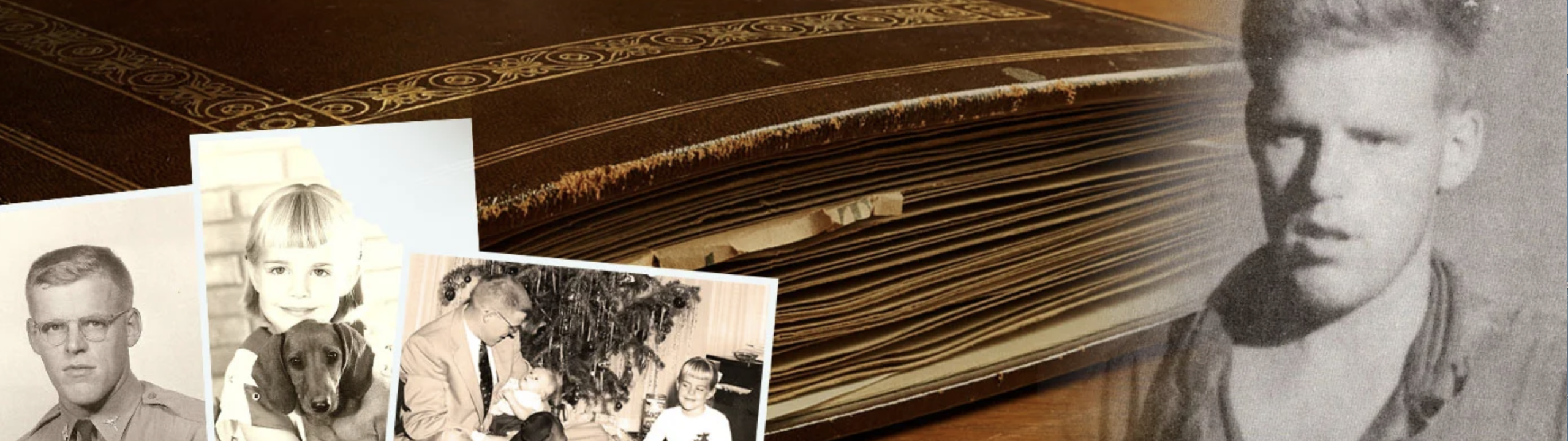
The War Came Home With Him
“It’s hard to imagine in this time of endless psychological examination that greater consideration was not given in the past to post-traumatic stress disorder (PTSD) and other conditions affecting returning POWs. Madison’s dual narratives of the injury visited upon, and imposed by her father raises complex questions of survival and forgiveness, relevant to readers dealing with family traumas themselves.”
Therese Purcell Nielsen, Library Journal
Prologue:
The War Came Home With Him
On this February night, my father is a bag of bones lying on his side under a thin hospital blanket. He is seventy-eight and his kidneys are failing. His cheeks are sunken and his limbs spindly, like those of an awkward teen in a growth spurt. My fingers, long and thin like his, could encircle his leg. Now without his glasses, he squints at the 2002 Olympic figure skaters on a television suspended awkwardly from the ceiling. He peers out at me—his small, nearsighted eyes the blue of robin eggs—from a long face whiskered in white, and attempts the crooked grin I barely remember.
“I liked that ballet, you know,” he says.
Only he doesn’t say ballet the usual way, baallay. He says the baal part like ball, as in basketball, the only sport he ever mentioned playing. I don’t understand what he means at first, so I have to ask. Twice. He gestures at the graceful movements on the screen and explains that as a teenager, he used to travel from Pelican Rapids, the small northern Minnesota town where he grew up, to the Twin Cities of Minneapolis and St. Paul. Where he saw “the ballet, you know.”
I don’t know this. I have never heard this before. I can’t even imagine this.
In my mind he is ten feet tall with a fist like a piston and a voice like Zeus. Perched on a pedestal of medical skill and military might, he commanded our family with high standards and harsh discipline. He went to war and returned a hero. But he declined to cheer our victories from high school bleachers, celebrate our report card A’s, or say I love you out loud. He reminded us often that we were just like everyone else—he loathed pomp and pretense—yet he stood alone and apart. He used force and fear to push us to be stronger, try harder, aim higher, to survive when someone else might not. Behind his back we call him Colonel Surgeon Father God.
He is my father, but I cannot hug him the way a daughter should. Not now, not the last time I saw him when I spent fewer than twenty-four hours at his house two years ago, and not since I was old enough to know what it means to hug your dad. When I try, he stands ramrod straight, his feet slightly turned out, his hands dangling from skinny arms held close to his sides, his jaw set. I can reach my arms around him, which in recent years I have mustered up the courage to try, but he is like a flagpole. Cold, hard, upright. A patriot, stilled.
And yet I know he wasn’t always this way. Before my mother died from lung cancer in 1995, she sent a videotape as a Christmas present. Labeled “Precious Moments,” the black plastic cassette contained pieces of old home movies transferred from the 8 mm film in the heavy cans we hauled from one basement to another every time we moved. Watching that video the first time, I saw familiar images of Easter morning in Germany, when I wore white patent leather shoes and a wide feathered headband, and Christmas morning in Texas, when I sat sweating in a green felt skirt and pretending to smile. But the video opened with a shocker: a clip of my parents’ wedding in my mother’s hometown of Boonsboro, Maryland.
There she was, nervous, looking like Lauren Bacall with wide turquoise eyes and perfectly arched eyebrows, milk-white skin, full lipstick-red lips, and dark brunette hair ringing her shoulders in curls. Even though she was wearing ballet slippers—she once confessed this to me in hushed tones, as if she had engaged in some anti-high-heel conspiracy—she was trying hard not to trip down the steep steps of the red brick church in her shiny gown and sweeping train. And there beside her, offering his arm, was my father—a jokester, loose-limbed and laughing, acting the goof.
I hit rewind. There he was again. He kissed her on the cheek and whispered in her ear, right there in public. I had no doubt that after the camera ran out of film, he would have not only hugged her but also swung her around in glee, train and all. I was seeing this, but I couldn’t make sense of it. My mother had told me stories of their college escapades, the time he got drunk and dumped water over his head to sober up, only to have his wet hair freeze straight-up solid as he walked her back to the dorm. The time he took her sailing, when the wind died and she missed curfew. I loved hearing these stories, but they weren’t about the man I called my father. That man was stern and serious, principled and aloof, unpredictable. He scared me.
He scares me still.
On my way to the hospital that February night, I gripped the steering wheel of the rented car in strangled fear, the fear I used to feel when I barely came up to his waist and then his shoulder, when he towered over me and shouted me down with a voice I couldn’t match. It has never gone away, that power he possesses. As I sit looking at him now, shrunken in his cranked-up bed, I wonder what almighty fire could have forged that steel.
I know, of course, that the answer lies in his past as well as in my own. Some of our past is shared—the years he spent training to be an army surgeon, then commanding army hospitals in Vietnam and Japan. But earlier years he spent as a prisoner of war in Korea are a yawning, silent chasm that wraps us in solitary, shamed cocoons. My brothers and I know only the basics: the existence of a cruel guard called the Tiger, a wintry mountain trek called the Death March, the evil called Communism. Shards of his story pierce the silence at odd times in odd ways, but for the most part, he does not tell us what we long to know, and we do not ask.
Tonight, as I sit with my questions, I think of all there is, unspoken, between us. I wonder whether it matters anymore. For once, my silence feels voluntary, uncompelled.
He has scooted too far down in bed to see the TV and asks me to call the nurse. When she comes, I go to one side of the bed while she takes the other, and on the count of three we grab the sheets folded under him and lift. It takes two tries to get him to the right spot. I am surprised at how light he is, and how it is possible for me to move him at all. This man, so heavy in my life, weighs less than I thought, less than what makes me afraid. How long has it been this way?
*** My father died, his secrets intact, in 2002. While cleaning out his office, my brother yanked too hard on the bottom drawer of his military gray file cabinet, pulling it all the way out, onto the floor. Underneath, we discovered a fat, faded Department of the Army manila envelope we’d never seen. Across the top, our mother had written: “The Whole Story!!” The details it contained, coupled with the beginnings of a memoir on my father’s computer and writings by his fellow POWs, comprise every other chapter of this book. The alternating chapters, stories from my life, illuminate the deleterious effects of PTSD and how they are passed down through generations.
Excerpt:
San Antonio, Texas, after my father returned when the Armistice Agreement was signed in 1954.***
Sunlight filtered through the dusty Venetian blinds and made long line patterns on the bare floor of my room in the front corner of our new house. It was early and still cool, and I wanted someone to read with me before it got too hot to sit close and turn the pages. I listened for movement in my parents’ room across the hall. I could see through my open door that their door was almost closed, which meant it was Sunday. On any other day, my father would already have left for work at Fort Sam Houston, where he was a surgery resident.
I was glad to have a daddy now like everybody else, even though I hardly ever saw him. Now that it was summer, my mother wanted an air-conditioner, but my father said not yet, we could do without for a while. He was always doing without. He skipped lunch, which made my mother crabby because she was used to three meals a day, but he said he just forgot to eat. And he liked to sleep on the floor. On Sunday afternoons he would stretch out on the living room rug, so my mother had to step over him to get to the kitchen. I was careful to go around because I was afraid.
I slid off my bed and tiptoed across the hall, the wooden floor cool on my feet, then stopped to listen. I heard only loud breathing. I pushed the door open and went in. My father wasn’t sleeping on the floor. He was on the bed next to my mother, who was curled on her side, facing away from him, with the white sheet twisted at their feet. She was wearing her blue shorty nightgown, but he was naked. My mother had bought him pajamas but he left them in the package; he didn’t need clothes to sleep.
I took one step forward to see if he was waking up. His eyelids didn’t move. He looked funny without his glasses. His arms were crossed on his stomach. He made a little noise every time he breathed out. I didn’t know if it was OK to ask for breakfast yet so I just stood there, waiting.
Suddenly his right arm smacked my chest as he bolted out of bed and flung me high across the space between bed and wall. My back hit the wall with a thud, and I crashed in a heap on the floor. My mother screamed. I didn’t move because I couldn’t breathe.
“He didn’t mean to, he didn’t mean to,” my mother kept crying as she picked me up and carried me to my room. My chest hurt. Sobs were starting to come in gasps. “You just startled him,” she said as she sat me on the bed. But I didn’t do anything, I thought. I only watched.